Is Google Still the Top Discovery Marketing Channel?
Google holds 90% of global search market share, so the assumption that it is still the front door to the internet is mostly right. But 'mostly right' is doing a lot of work. This is Phase Zero of the Real SEO™ AI citability experiment ... the question before the answer.
Every content strategist operating in 2026 is sitting on the same uneasy assumption: that Google remains the front door to the internet, and that SEO ... in whatever form it takes this year ... is still the master key. The data says they are mostly right. But "mostly right" is doing a lot of work in that sentence.
Google holds 90% of global search market share as of early 2026. In the United States specifically, that number has slipped below 85% for the first time ... a milestone that would have seemed unthinkable five years ago. Bing has climbed to its highest-ever U.S. share at 10.48%, powered by Microsoft's Copilot AI integration. AI-powered search platforms, as a category, grew 225% year over year.
None of these facts dethrone Google. But together they describe a market that is no longer stable ... a dominant player whose dominance is being hollowed out from beneath, even as the headline number holds.
What they cannot tell you is what any of this means for a content publisher building for long-term authority ... specifically, for one trying to earn AI citations rather than chase traditional organic rankings. That is the experiment this article begins.
- 01 ... Is Google still the discovery channel ... or has it become primarily the transaction channel, while AI handles thought?
- 02 ... If 60% of searches now end without a click-through, what does "ranking" even mean for a content publisher?
- 03 ... Only 37% of marketers are currently optimizing for AI search. Is that a gap ... or a window closing fast?
- 04 ... "The fight isn't for position one anymore ... it's for contextual inclusion inside the model's response." Can you engineer that, or only earn it?
- 05 ... AI ads are coming ... ChatGPT, Perplexity, Google AI Mode are all heading there. Is organic AI citation the last free-attention window before monetization locks it down?
- 06 ... What does a site actually need ... technically, structurally, and editorially ... to earn citations from LLMs rather than just rank on a search page?
These are not rhetorical questions. They are the working hypotheses of this experiment ... each one a thread that the data, the framework, and the case study that follows will attempt to pull.
I. Google Handles Transactions. AI Handles Thought.
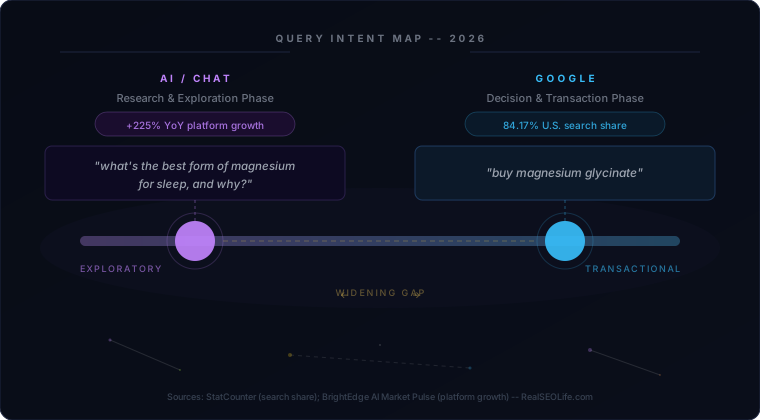
One of the sharpest observations to emerge from 2026 industry analysis: "Google is the place you go when you already know what you want. Chat is the place you go when you don't." That gap, observers argue, is widening ... not narrowing.
This reframing has direct consequences for content strategy. If Google increasingly captures high-intent, transactional queries while conversational AI captures exploratory, research-phase queries ... then the two surfaces require fundamentally different content architectures. Ranking for "buy magnesium glycinate" is a different problem than being cited when someone asks an AI assistant "what's the best form of magnesium for sleep, and why?"
The AI Digital Karma Federation's portfolio ... built around health, wellness, and supplement authority ... lives almost entirely in the second category. That is not a vulnerability. It is a positioning opportunity, if the content is structured correctly.
"The fight isn't for position one anymore. It's for contextual inclusion inside the model's response." ... Rita Steinberg, VP of Media, FUSE Create (eMarketer, January 2026)
II. The Zero-Click Problem Reframes the Metric
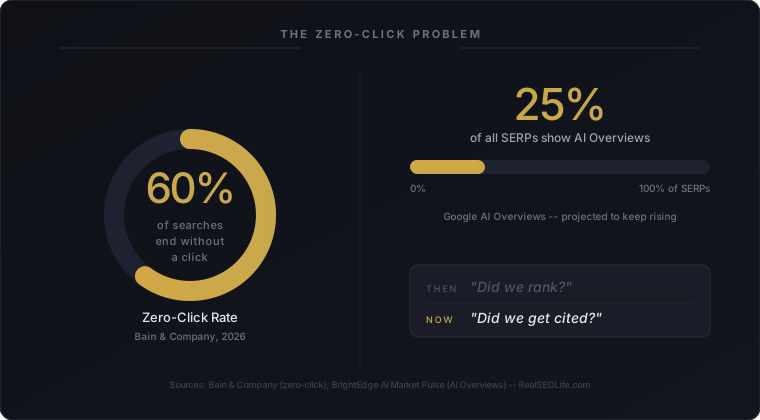
Approximately 60% of searches now end without a click-through, per Bain & Company data. Google's AI Overviews appear in roughly 25% of all SERPs, a figure projected to keep rising. Google's AI Mode synthesizes dozens of sources into a single answer. No guaranteed visit. No impression. No click.
The implication is direct: traffic is increasingly decoupled from visibility. A site can be heavily cited by AI systems (shaping the answers millions of people receive) while registering declining pageviews in Analytics. Traditional SEO metrics measure the wrong thing in this environment.
The question is no longer "did we rank?" It's "did we get cited?" Those are very different technical and editorial challenges.
III. The 37% Gap ... Opportunity or Illusion?
According to UserTesting's 2026 marketing priorities survey, only 37% of marketers are actively optimizing content for AI search. The instinctive reaction is to read this as opportunity ... a wide-open lane for early movers.
The more careful reading is more interesting. The 63% who are not optimizing for AI search are not necessarily losing yet. AI systems still draw heavily from the same authority signals that traditional SEO rewards: depth, structure, cited sources, domain credibility, E-E-A-T signals. The difference is that AI-native optimization requires a layer of additional architecture ... machine-readable endpoints, structured schema, natural-language FAQ formatting, attributable data ... that most sites have not built.
The window is real. It may not be as wide open as it appears, but it is unquestionably earlier in its monetization cycle than traditional search ever was at this stage. AI platforms are currently organic and unsponsored ... a direct parallel to early Google. And early Google rewarded the builders who moved first.
IV. Can You Engineer AI Citation ... or Only Earn It?
This is the core technical question, and the honest answer is: both, in different proportions. You cannot buy your way into an LLM's response the way you can buy a paid search placement. But you can substantially increase the probability of citation through deliberate content and infrastructure choices.
The current consensus among professionals points to several consistent factors: specificity over volume (deep reference articles outperform thin cluster content), structured data and schema markup that makes content machine-parseable, natural-language question formatting that mirrors how queries are actually phrased to AI assistants, attributable data points tied to named sources, and consistent entity signals across a domain.
The emerging pattern suggests that AI citation is less like gaming an algorithm and more like building the kind of source a researcher would cite ... because that is, architecturally, what AI systems are doing. They are running fast research operations. They cite what they trust.
V. The Last Free-Attention Window
One of the most consequential facts in search right now: AI citation surfaces ... ChatGPT search results, Perplexity citations, Google AI Mode references ... are currently unsponsored. There is no paid placement. The platforms pick who shows up. Google runs ads in AI Overviews across 12 countries and is testing further. Perplexity has piloted sponsored questions. ChatGPT's CFO has signaled that advertising is coming.
Every major AI search surface is following the same arc early Google followed ... organic dominance first, monetization second. The builders who established authority in the organic phase of Google, from 2003 to 2008, captured positions that proved durable for fifteen years. That window, for AI citation, appears to be open now.
Whether it closes in 18 months or 5 years is uncertain. That it closes is not.
VI. What This Means for the AI Digital Karma Federation
The federation model ... a cluster of interconnected authority sites sharing structured data through /ai/catalog.json endpoints ... was designed, in part, for exactly this moment. Each property in the network builds authority in a specific niche. The structured catalog endpoints allow AI systems to traverse the network's knowledge graph. The interconnected citation signals reinforce each property's authority claim.
NaturalHerbLibrary.com is the federation's first formal Real SEO™ test case because it sits where the stakes are highest: a subject area (supplements, longevity, metabolic health) where AI Overviews appear frequently, where generic AI-recommended retailers dominate, and where genuine specialist expertise ... cited, structured, attributable ... represents a defensible competitive advantage that a large retailer cannot easily replicate.
The data says Google is still the top discovery channel. The more important question for 2026 is: who gets cited when Google ... or any AI system ... answers the question you spent years learning how to answer? That is what this experiment is designed to find out.
Phase Zero ... The Question Has Been Asked
Hypothesis: A static HTML site with no domain authority, built with deliberate AI-native content architecture ... structured schema, machine-readable endpoints, deep reference articles, and natural-language FAQ formatting ... can earn citations from major AI systems (ChatGPT, Perplexity, Claude, Google AI Mode) within 90 days of launch, outperforming comparable sites that rely solely on traditional SEO signals.
Test property: NaturalHerbLibrary.com. Measurement: AI citation rate across major LLMs for target queries in the supplement and longevity space. Time-to-first-citation as the key metric.
Each subsequent article in this series documents one thread from this seed ... Google as transaction channel, zero-click ranking, the 37% gap, engineered vs. earned citation, the AI ad window, LLM citation requirements. The experiment becomes the case study. The seed article becomes the citation record.
This is Phase Zero. The question has been asked. The framework has been named. The build begins now.

See Where These Ideas Get Tested
The case studies and experiments are where the ideas in these articles get tested on live sites.