Bot-Weighted SEO: The Open Case Study I Am Running Now
I do not have clean proof that bot-first SEO is better. Not yet. That is why this belongs as an open case study, not a victory lap.
I do not have clean proof that bot-first SEO is better.
Not yet.
What I have is a working suspicion from the portfolio.
The sites where I have done the most aggressive implementation using bot-weighted decisions appear to be the sites getting the bigger returns.
That could mean the model is working.
It could also mean something simpler: those sites got more work.
That is exactly why this belongs as an open RealSEOLife case study instead of a polished success story.
The Thesis
The working thesis is simple.
Good-bot activity gets the strongest weight.
Human page requests come second.
Search impressions come third.
That is not because impressions do not matter. They do.
Impressions show where Google is already testing pages.
Human page requests show where real people are already touching the site.
But good-bot activity may show where search systems, AI systems, and crawler layers are reading before the visible search result catches up.
That is the part I want to test.
Why AS400Software.com Became The Example
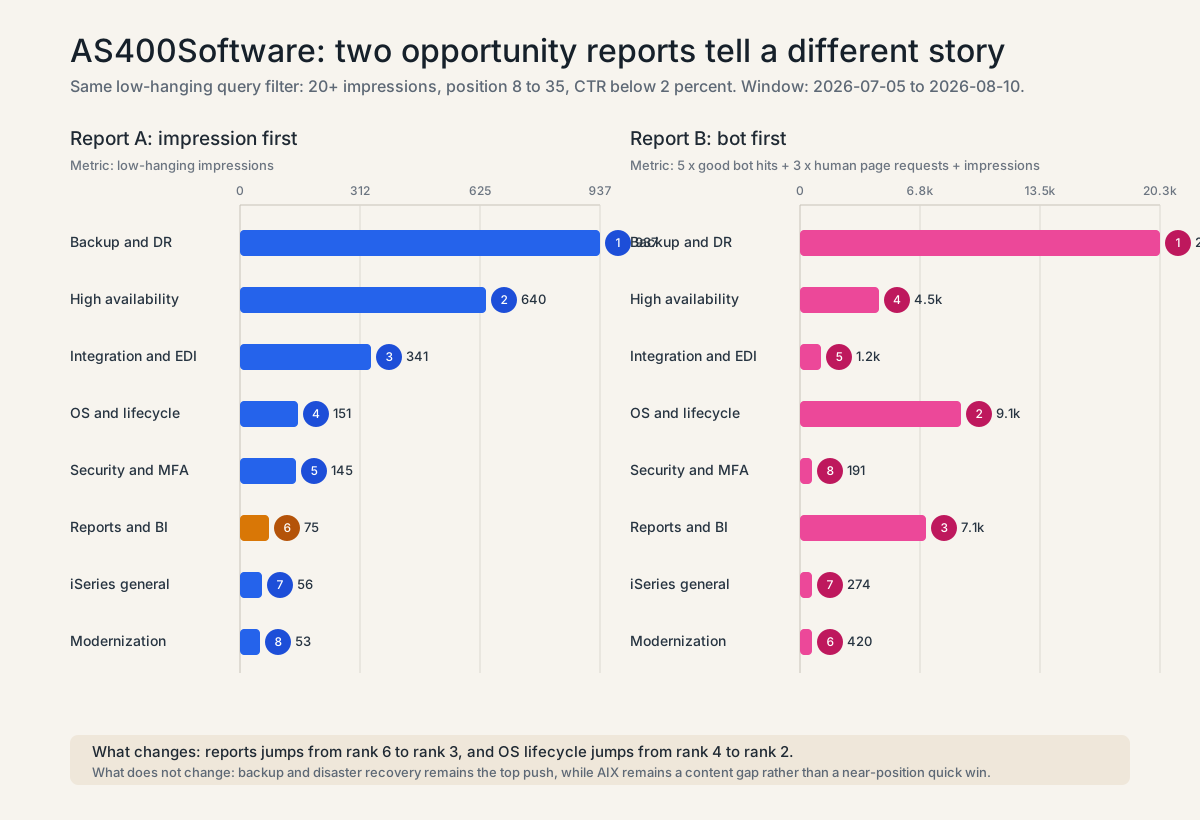
AS400Software.com is a clean example because the normal report and the bot-weighted report point at different priorities.
The impression-first view says backup and disaster recovery is the obvious push. It also says high availability has strong low-hanging value.
That is useful.
But when good-bot activity gets the heaviest weight, the shape changes.
Backup and disaster recovery still wins.
Reports and BI move higher.
OS and lifecycle terms move higher.
High availability drops from a near-term impression opportunity into a smaller bot-weighted priority.
That does not make the first report wrong. It means the two reports are asking different questions.
The Problem With Calling It Proof
I do not want to overstate this.
If I push a site harder and that site grows, the growth may come from the extra implementation volume.
That is a real confounder.
The bot-weighted model may be selecting better targets.
Or the bot-weighted model may simply be giving me the confidence to do more work.
Both outcomes matter.
In real SEO, confidence changes implementation. Implementation changes outcomes.
So the question is not only whether bot activity predicts future growth.
The better question is whether bot-weighted analysis creates better decisions than impression-only analysis.
What I Am Actually Doing With The Signal
I am not using bot activity as a magic ranking factor.
I am using it as a prioritization signal.
When a topic has good-bot attention, human requests, and even a modest GSC footprint, it moves up the work queue.
That usually means one of five things needs a push.
The page needs clearer structure.
The topic needs a supporting page.
The internal links need to make the relationship obvious.
The entity signals need to be less vague.
Or the site already has attention and just needs a stronger answer at the exact point the machines are reading.
How This Case Study Will Be Tracked
Decision Inputs
- Good-bot requests by topic, query, page, and site
- Human page requests by the same topic buckets
- Google Search Console impressions, clicks, CTR, and average position
- Existing content depth, internal links, and entity clarity
Implementation Log
- Pages updated from a bot-weighted priority list
- New supporting pages created from bot-first gaps
- Internal links added to strengthen machine-readable relationships
- Structured data, headings, and page copy tightened where the crawler activity is already present
Outcome Checks
- 30-day movement in good-bot activity
- 30-day movement in human page requests
- 60-day movement in GSC impressions and average position
- 90-day movement in clicks and query spread
- Cases where bot-weighted priorities failed to move
What the Portfolio Changed About the Question
The first version asked whether bots predict rankings.
That is too simple.
The August 4 digital-asset campaign gave me thirteen new pages. By September 8, all thirteen had received successful crawler requests, eight had Google impressions, and none had a click.
Then the AS400System family handed me the reverse case. Google impressions fell 85.8 percent in one week while recognized crawler activity initially held.
Machine attention can show up before meaningful Google visibility. It can also remain after Google visibility disappears.
That is not a contradiction. It is the thing worth measuring.
I am calling the larger sequence Exposure Velocity: crawler activity, human requests, query expansion, impressions, citations, and clicks treated as separate signals that may move at different times. Bot weight can be one input. It cannot be the conclusion.
What Would Prove Me Wrong
The thesis loses strength if bot-weighted pushes do not beat impression-first pushes over time.
It also loses strength if good-bot activity stays high but GSC visibility, human requests, and clicks do not improve after the pages are cleaned up.
That is why I want the case study open-ended.
The point is not to protect the idea.
The point is to keep measuring it honestly.
Why This Is Real SEO
This is the kind of thing that does not fit cleanly into a normal SEO article.
It is not a tidy how-to.
It is not a finished case study with a clean before and after.
It is a live decision system inside a real portfolio.
The work is being done, the data is being watched, and the conclusion is still allowed to change.
That is more useful than pretending every SEO idea arrives fully proven.
The Current Read
I still trust bot-weighted reporting enough to help choose what I inspect next.
I do not trust a crawler request enough to call it demand, a ranking signal, a citation, or a future click.
That is the line.
What started as Bot-Weighted SEO is turning into Exposure Velocity. The useful question is not whether bots predict rankings. It is whether several early signals, measured separately, tell me an asset is gaining exposure before clicks make it obvious.
If every signal moved together every time, I would not be learning anything.

See Where These Ideas Get Tested
The case studies and experiments are where the ideas in these articles get tested on live sites.